
Home » Data Capture » Biometric Terminals
Biometric Clocking for Your Workforce
Tackling core HR and Personnel issues for small to medium sized companies. Addressing security and record integrity challenges, Chronicle HR removes the need for filing cabinets, paper records and excel spreadsheets.

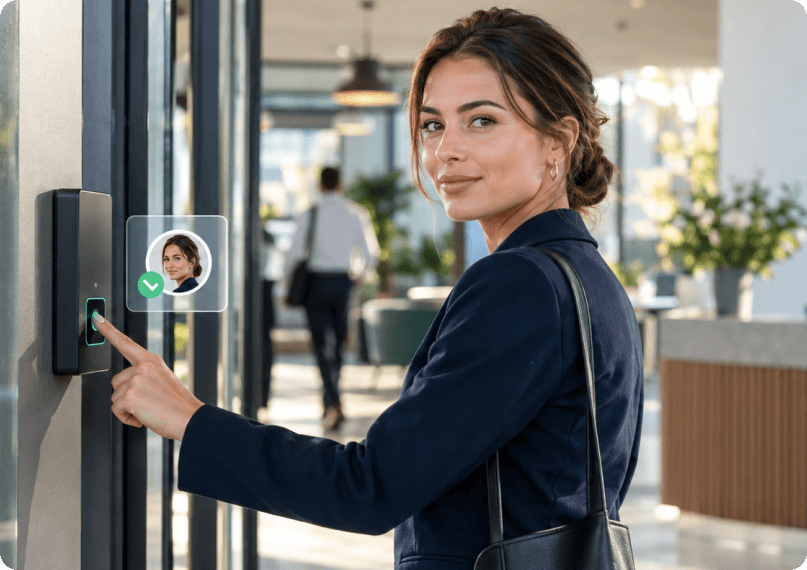
Eliminates buddy punching

Eliminates badges/tokens/PINs

Improves security
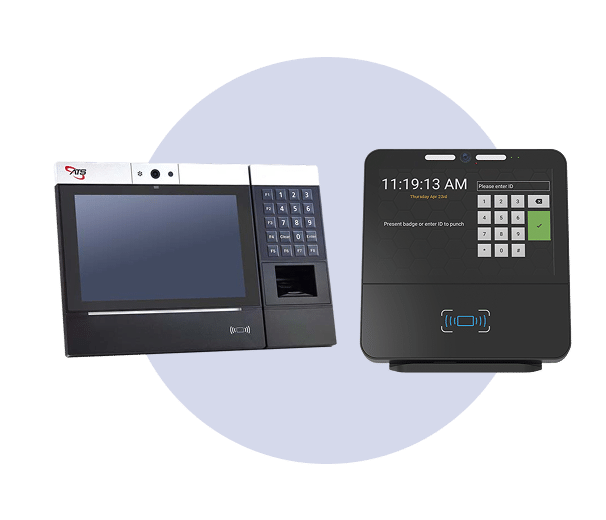
All our Time and Attendance Units have Standard
- A steel case with a lockable back.
- Memory and Battery Back-up as standard.
- Works in Live time.
- Synced to an atomic clock, so the device never loses or displays the wrong time.
- Powered and Networkable for constant up time and robustness.
User Confidentiality
Chronicle offers fingerscan biometric devices. Fingerscans are not fingerprints. Many people refer to fingerscans as “fingerprints,” but the data of a fingerscan template is not suitable for law enforcement fingerprint matching.
The Chronicle fingerscan products produce a template that represents points along the unique features and minutiae found in a fingerprint pattern. The template files cannot be reverse engineered to reproduce a fingerprint because the reader does not save the necessary information.
Reliability Rules
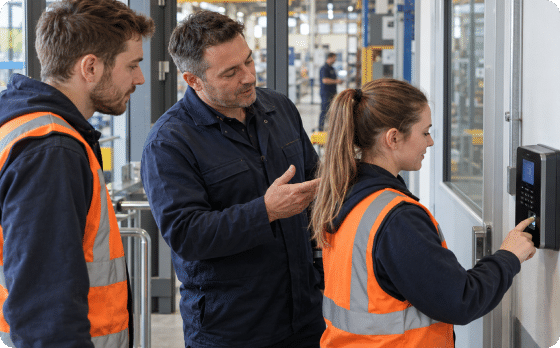
Successful biometric installation and use typically requires:
Management Support.
Training of Supervisors and Employees.
Satisfactory Environmental Conditions.

Even if all these requirements are met it’s important to note:
Not all users can be enrolled.
Devices are susceptible to vandalism.
Environmental conditions can affect operation.
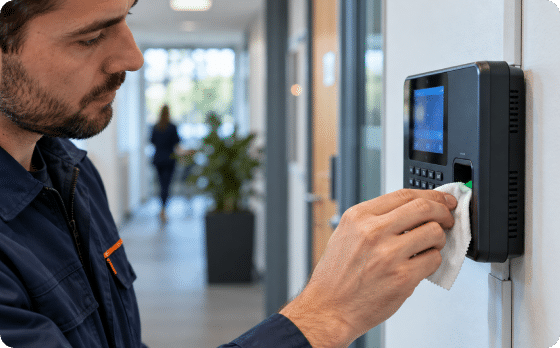
Chronicle uses reliable fingerscan technologies with simple rules:
Terminals within a facility are installed correctly.
Enrolment procedure is closely followed.
The sensor is maintained on a scheduled basis.
Frequently Asked Questions
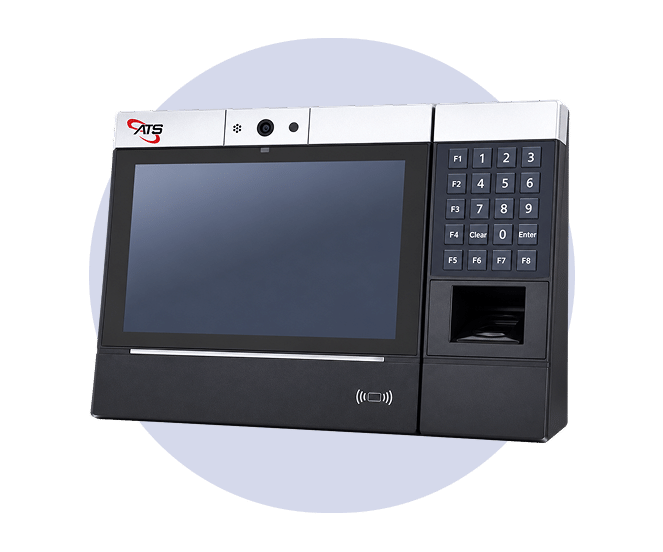
The Stride is an Android-based time and attendance terminal that can be configured with a fingerprint biometric reader.
Employees can use their fingerprint to verify their identity when clocking in or out, helping organisations maintain accurate attendance records and reduce the risk of one employee clocking for another. ATS lists biometric, proximity, keypad, swipe-card and barcode-reader configurations for the Stride platform. Accu-Time Systems, Inc.
An employee is first enrolled on the biometric system.
During enrolment, the fingerprint reader examines characteristics of the fingerprint and converts selected features into a digital biometric template. When the employee subsequently clocks, the system compares the new scan with the enrolled template to verify their identity. Accu-Time Systems, Inc.
No.
According to Accu-Time, its fingerprint biometric system converts fingerprint characteristics into data points which are stored as encrypted binary code. An image of the employee’s fingerprint is not stored. Accu-Time Systems, Inc.
That is an important FAQ to include because customers frequently assume the terminal keeps an actual fingerprint image.
The biometric reader analyses characteristics of the fingerprint, including features associated with its ridges and pattern.
These characteristics are converted into a mathematical or digital template that can subsequently be used to verify the employee. Accu-Time Systems, Inc.
The stored information is intended to be used as a biometric template for authentication rather than as a conventional fingerprint image.
For customer-facing wording, I would avoid making an absolute claim that reconstruction is technically impossible unless ATS specifically confirms that for the exact reader Chronicle supplies.
A card, fob or PIN establishes that somebody possesses the employee’s credential.
Fingerprint biometrics provide an additional level of identity verification because the employee must physically present their biometric characteristic at the terminal.
This is particularly useful for organisations seeking to reduce buddy punching, where one employee clocks another employee in or out. ATS describes biometric authentication as a means of verifying that the person at the clock is the employee concerned. Accu-Time Systems, Inc.
It can substantially reduce or effectively prevent conventional buddy punching when biometric verification is required for the clocking.
Unlike a card or PIN that can be handed to another employee, the biometric factor is associated with the individual employee. Accu-Time Systems, Inc.
The employee presents their finger to the biometric reader during the enrolment process.
The reader captures the relevant fingerprint characteristics and creates the biometric template that will subsequently be used during authentication. ATS describes enrolment as the initial scan used to create the employee’s personalised template. Accu-Time Systems, Inc.
No actual fingerprint image is stored by the ATS biometric process described by the manufacturer.
The biometric scanner converts the relevant fingerprint characteristics into data points and stores these as an encrypted biometric template. Accu-Time Systems, Inc.
For your website, I would still separately confirm where Chronicle’s particular implementation stores the template — terminal only, Chronicle database, ATS middleware, or a combination — before saying anything more specific about storage location.
The employee presents their fingerprint to the reader.
The biometric system uses the scan to authenticate the employee against the enrolled biometric template. Once successfully authenticated, the employee can complete the relevant Chronicle transaction, such as clocking in or out.
Yes.
The Stride platform is designed for time and attendance transactions including clocking in and out, breaks and other configured workforce transactions. ATS also supports configurable workflows for employee transactions. AccuTime Blog
Yes.
Depending on the Chronicle configuration, employees can use the terminal for transactions such as:
- Clock In
- Clock Out
- Start Break
- End Break
- Meal Break
- Department, job or task transfers
ATS specifically lists shift clockings, meal/rest breaks and job or task transfers among supported Stride employee actions. AccuTime Information
The employee can present their finger again.
Poor finger placement, contamination, moisture, damage to the finger or other physical factors can occasionally affect fingerprint recognition.
If an employee repeatedly experiences difficulty, their biometric template may need to be reviewed or the employee may need to be enrolled again.
The Stride can be configured with keypad functionality, so PIN or employee-ID authentication can be provided depending on the terminal configuration. Accu-Time Systems, Inc.
Organisations should establish an alternative clocking process for employees who cannot or should not use biometric identification.
ATS specifically recommends that biometric terminals have an alternative reader option or at least PIN entry available for employees who do not participate in biometric clocking. Accu-Time Systems, Inc.
Yes.
Fingerprint templates used to uniquely identify or verify employees constitute biometric information and should be treated accordingly under applicable data-protection legislation.
Organisations should have appropriate privacy, security and retention processes in place before implementing biometric clocking.
This depends on the applicable jurisdiction and the employer’s legal basis for processing biometric data.
ATS advises organisations using biometric readers to review applicable legislation and their privacy and security procedures before collecting biometric information. Accu-Time Systems, Inc.
For UK customers, I would not simply write “yes, consent is required” because UK GDPR employment-law treatment is more nuanced than that.
For UK organisations, biometric processing used to identify employees is the type of processing where a Data Protection Impact Assessment should normally be seriously considered.
Chronicle can explain how the terminal and system operate, but the customer remains responsible for determining its legal basis and data-protection obligations.
Biometric templates should be capable of being removed when they are no longer required, subject to the customer’s system configuration and retention policy.
ATS also advises organisations to consider mechanisms allowing employees’ biometric data to be permanently deleted. Accu-Time Systems, Inc.
The Stride platform is specifically designed to handle employee interaction and biometric authentication quickly.
ATS states that its processing power and memory are intended to keep employee lines moving during biometric authentication, particularly around busy shift changes. Accu-Time Systems, Inc.
Yes.
The Stride 80 uses an 8-inch multi-touch colour screen. ATS’s current product literature also shows an Android operating system and configurable peripheral options. AccuTime Information
The Stride 80 is an Android-based terminal. Accu-Time Systems, Inc.
ATS currently specifies the Stride 80 with:
- Quad-core A7 1.1 GHz processor
- 2 GB memory
- 16 GB non-removable eMMC storage
- At least 10 GB user-available storage Accu-Time Systems, Inc.
The Stride supports Ethernet connectivity and can also be configured with Wi-Fi or cellular connectivity.
ATS lists:
- 10/100 Ethernet
- DHCP or static IP
- 2.4 GHz Wi-Fi
- Optional 4G cellular modem Accu-Time Systems, Inc.
Yes.
ATS lists optional IEEE 802.3at PoE+ support for the Stride 80. Accu-Time Systems, Inc.
An optional lithium-ion battery is available, with ATS specifying up to approximately one hour of operation depending on configuration and conditions. Accu-Time Systems, Inc.
Yes.
Where multiple Chronicle terminals are installed, employees can be configured to clock at authorised terminals across the organisation.
Yes.
A customer can use fingerprint biometric terminals in areas where stronger identity verification is required while using proximity, mobile, desktop or other Chronicle clocking methods elsewhere.
Once the employee has been successfully authenticated, the attendance transaction is sent into the organisation’s time and attendance system.
Within Chronicle Online, this can then form part of the employee’s timesheet and be processed against working patterns, shifts, exceptions and payroll rules.
Fingerprint terminals provide:
- Positive employee authentication
- Reduced opportunity for buddy punching
- No requirement for employees to carry a card or fob
- Fast clocking at the workplace
- Accurate time and attendance capture
- Configurable clocking workflows
- Alternative card or PIN options where configured
- Integration into Chronicle Online
- Greater confidence that the person recording the clocking is actually the employee concerned
Neither technology is universally better.
Fingerprint biometrics provide a familiar, highly established method of employee verification. Facial recognition can provide a more contactless experience and may be preferable in environments where touching a reader is undesirable.
Chronicle can recommend the most suitable technology based on the workforce, working environment and customer’s requirements.
It depends on the customer’s objective.
Proximity cards are extremely quick and simple but can potentially be passed between employees.
Fingerprint biometrics provide stronger identity verification because the employee themselves has to authenticate at the terminal.
Yes.
Chronicle can assist with terminal configuration, employee setup, enrolment procedures and integration with Chronicle Online.
Customers should also establish their own biometric privacy, retention and employee communication policies before introducing biometric clocking.

