
Home » Data Capture » Portable Biometric Terminals
Portable Biometric Terminals
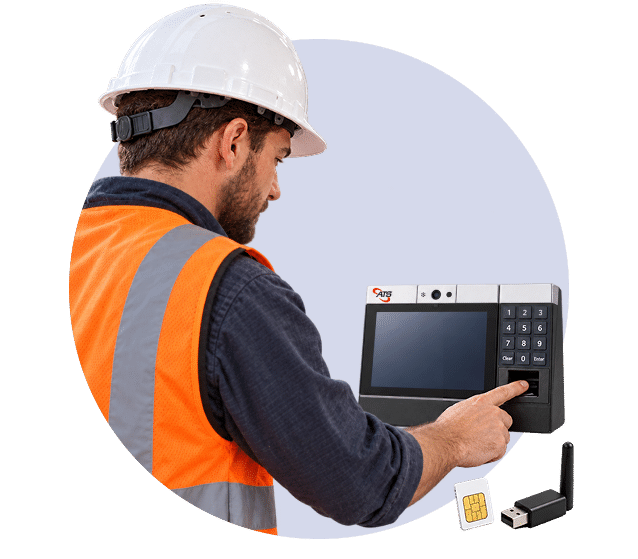
Our clients in Construction and Event Industry use the Chronicle Online Mobile Biometric clocking terminal to track hours.
With no network or data point required our Mobile offering is simple and easy to set up and a great reliable solution.
Portable Clocking
Track employee hours on construction sites & at events.

Simple Setup
Get started without a fixed
network or data point.

Biometric Identification
Identify employees using finger scan technology.

Built-In Backup
Memory & battery backup increase reliability.
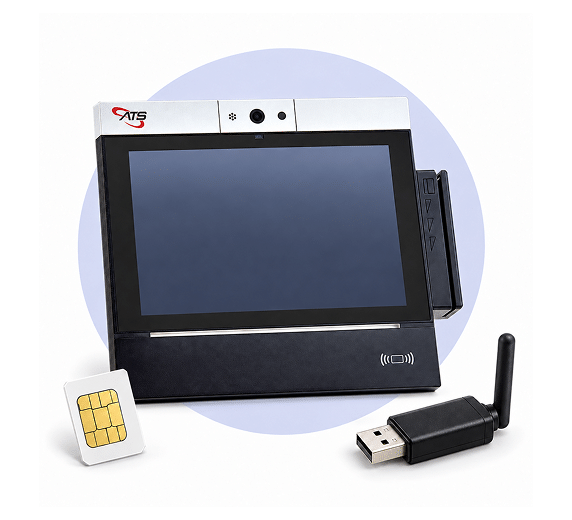
All our Time and Attendance Units have Standard
- A steel case with a lockable back.
- Memory and Battery Back-up as standard.
- Works in Live time.
- Synced to an atomic clock, so the device never loses or displays the wrong time.
- Powered and Networkable for constant up time and robustness.
User Confidentiality
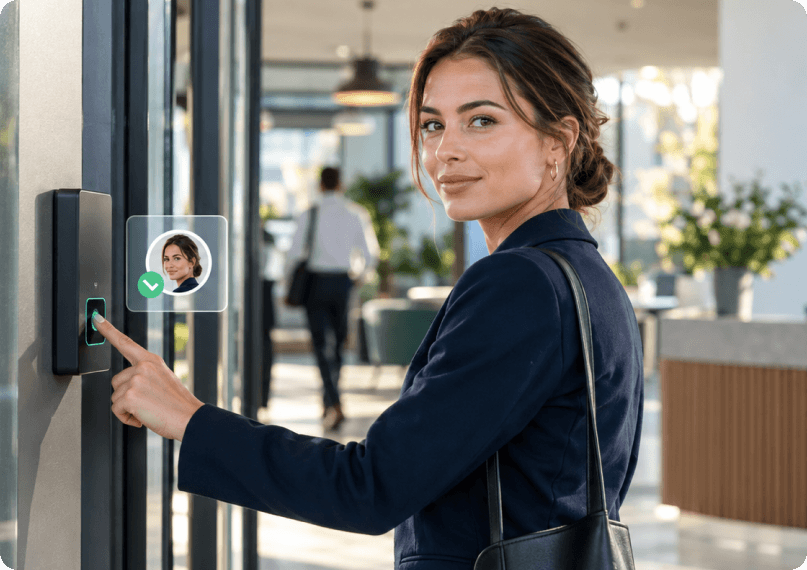
Chronicle offers fingerscan biometric devices. Fingerscans are not fingerprints. Many people refer to fingerscans as “fingerprints,” but the data of a fingerscan template is not suitable for law enforcement fingerprint matching.
The Chronicle fingerscan products produce a template that represents points along the unique features and minutiae found in a fingerprint pattern. The template files cannot be reverse engineered to reproduce a fingerprint because the reader does not save the necessary information.
Reliability Rules
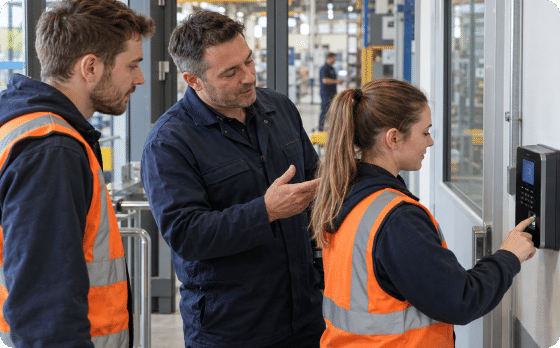
Successful biometric installation and use typically requires:
Management Support.
Training of Supervisors and Employees.
Satisfactory Environmental Conditions.
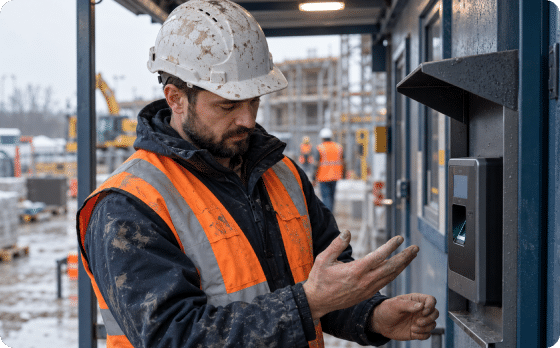
Even if all these requirements are met it’s important to note:
Not all users can be enrolled.
Devices are susceptible to vandalism.
Environmental conditions can affect operation.
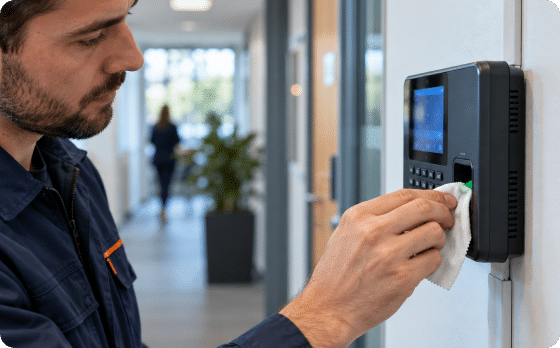
Chronicle uses reliable fingerscan technologies with simple rules:
Terminals within a facility are installed correctly.
Enrolment procedure is closely followed.
The sensor is maintained on a scheduled basis.
Frequently Asked Questions
A portable SIM-enabled terminal is a time and attendance device that can communicate over a mobile 4G network rather than relying solely on a customer’s fixed Ethernet or Wi-Fi connection.
This makes it useful for temporary sites, remote locations, construction projects, mobile workforces and locations where conventional network infrastructure is unavailable.
The terminal uses a compatible mobile data connection through an internal cellular modem.
Once connected to the mobile network, the terminal can communicate with the workforce management system and transmit employee clocking data. Accu-Time lists an optional 4G cellular modem on terminals such as the Stride 80 and PeoplePoint Plus. Accu-Time Systems, Inc.
No.
Where the terminal is configured with a cellular modem and an active mobile data connection, it does not need to rely on the customer’s Wi-Fi network for communication.
This can make deployment considerably easier at locations where local network access is unavailable or undesirable.
Not necessarily.
Compatible ATS terminals can support Ethernet, Wi-Fi and cellular connectivity depending on their configuration. A SIM-enabled installation can therefore use the mobile network instead of a fixed Ethernet connection. Accu-Time Systems, Inc.
It can be used as a highly flexible or relocatable clocking solution, but “portable” does not necessarily mean handheld.
The terminal still requires an appropriate power source and a suitable location for employees to use it. Depending on the model, optional battery backup may also be available.
This depends on the model and specification.
For example, the Stride 80 supports an optional lithium-ion battery which ATS specifies as providing up to approximately one hour of operation. Accu-Time Systems, Inc.
The battery is therefore better considered a short-term backup rather than an all-day independent power supply.
No, not normally.
These terminals are designed to have a permanent power source. Where fitted, the battery provides temporary operation during a short power interruption rather than replacing the terminal’s normal power supply.
A cellular terminal is particularly useful where providing conventional network connectivity is difficult.
Typical examples include:
- Construction sites
- Temporary offices
- Remote facilities
- Site cabins
- Warehouses
- Outdoor projects
- Events
- New premises awaiting network installation
- Multiple temporary work locations
- Locations where access to the customer’s corporate network is restricted
Yes, SIM-enabled clocking terminals can be particularly useful for construction.
A site can be equipped with a clocking terminal without needing the terminal to be connected to the main corporate network, provided suitable mobile coverage and power are available.
For particularly harsh or exposed environments, the environmental rating of the specific terminal should also be checked.
Yes, subject to the installation and configuration.
A cellular connection reduces dependence on the network infrastructure at a specific building, making the terminal considerably easier to relocate between sites.
Power, mobile coverage and any mounting requirements still need to be considered.
It requires adequate compatible mobile data coverage.
Performance therefore depends on the mobile network available at the installation location, just as it would with any other cellular-connected device.
Chronicle would recommend confirming network coverage before deploying the terminal at a remote location.
Depending on the terminal and Chronicle configuration, clocking transactions can be retained and transmitted once communication is restored.
This means a temporary loss of mobile connectivity does not necessarily mean employees are unable to make clockings.
A temporary communication failure should not automatically mean the clocking itself is lost where the terminal is configured to retain transactions locally.
Once communication is restored, outstanding transactions can be transmitted to the central system.
The exact offline behaviour should be confirmed for the terminal configuration supplied.
Yes.
The purpose of the communication connection is to transmit employee clocking information back into the workforce management system.
Once received by Chronicle Online, the transactions can form part of the employee’s attendance record and be processed through timesheets, working patterns, exceptions and payroll rules.
Time and attendance transactions themselves are relatively small compared with typical consumer mobile-data usage.
Actual consumption will depend on the terminal configuration, software updates, communication frequency and any additional features being used.
Chronicle can advise on the appropriate connectivity arrangement for a deployment.
This depends on the commercial arrangement.
A terminal can be supplied/configured for cellular connectivity, but customers should confirm with Chronicle whether the SIM and mobile-data service are included or need to be provided separately.
Yes.
The SIM requires an active mobile-data service appropriate for the network and country in which the terminal will be used.
Potentially, depending on the terminal modem, network compatibility and Chronicle configuration.
This should be agreed with Chronicle before deployment so that network compatibility and configuration can be confirmed.
This depends on the modem and SIM arrangement supplied.
Chronicle should confirm the supported network configuration before installation, particularly where the terminal will be used across different locations or countries.
Yes, compatible Accu-Time terminals can be configured with an optional 4G cellular modem. The Stride 80, for example, lists 4G cellular connectivity as an available communication option. Accu-Time Systems, Inc.
Potentially, yes.
ATS terminal platforms can support multiple communications technologies, including Ethernet, Wi-Fi and cellular connectivity, depending on the hardware configuration supplied. Accu-Time Systems, Inc.
This can provide additional flexibility where more than one connection method is available.
The available identification methods depend on the terminal supplied.
Compatible terminals can support options including:
- Proximity cards or fobs
- PIN numbers
- Barcode credentials
- Fingerprint biometrics
- Other biometric technologies
For example, ATS’s Stride platform can be configured with biometric readers, proximity readers, keypad entry, magnetic stripe or barcode scanning. Accu-Time Systems, Inc.
Yes, when configured with a proximity reader.
Employees can present their assigned card or fob to make a clocking without needing to enter a username or password.
Yes, compatible ATS terminal platforms can be configured with fingerprint biometric readers.
Whether fingerprint functionality is included depends on the exact terminal specification ordered. Accu-Time Systems, Inc.
Yes, where the terminal is supplied with keypad/PIN functionality.
This can also provide an alternative method of identification where a card or biometric method is not suitable.
Yes.
For example, an organisation could use:
- SIM-connected terminals on construction sites
- Ethernet terminals at its main office
- Wi-Fi terminals at smaller premises
- Mobile app clocking for remote employees
All authorised transactions can ultimately feed into the same Chronicle Online environment.
It depends on the requirement.
A dedicated terminal creates a defined workplace clocking point and does not require every employee to own, carry or use a smartphone.
ATS specifically positions purpose-built terminals as an alternative to relying solely on mobile devices, particularly where organisations require a consistently available workplace clocking point. Accu-Time Systems, Inc.
Yes.
Because the terminal is a physical device installed at an authorised location, employees have to attend that location to use it.
This can be useful for construction sites, temporary workplaces and dispersed operations where an employer wants a clearly defined clocking point.
Yes.
Multiple terminals can be deployed where a project has several entrances, compounds, work areas or temporary locations.
The resulting attendance information can still be managed centrally through Chronicle Online.
Yes.
One of the main benefits of cellular connectivity is that the terminal is less dependent on the network infrastructure of a particular building.
Once one project finishes, the terminal can potentially be redeployed at another location, subject to power, mobile coverage and any required reconfiguration.
Cellular connectivity removes the need to connect the terminal directly to a customer’s local Wi-Fi or Ethernet infrastructure.
The precise security architecture depends on the terminal, mobile-data arrangement and Chronicle configuration, so Chronicle should document the specific communication method supplied rather than making a generic claim that cellular connectivity itself is inherently more secure.
Employees will not be able to use the terminal while it is powered off.
Once it is powered back on and connectivity is restored, the terminal can resume normal communication.
Terminal communication and status monitoring capabilities depend on the deployed software and hardware configuration.
ATS provides remote terminal-management capabilities within its platform, including remote configuration and software management. Accu-Time Systems, Inc.
Yes, compatible ATS terminal platforms support remote software deployment and management, reducing the need to physically visit each terminal for routine software updates. Accu-Time Systems, Inc.
The principal benefits are:
- No reliance on the customer’s fixed network
- 4G mobile-data connectivity
- Faster deployment at temporary sites
- Suitable for construction and remote locations
- Easier relocation between sites
- Centralised attendance information
- Multiple employee identification options
- Reduced requirement for local IT infrastructure
- Useful where Wi-Fi or Ethernet cannot easily be provided
- Can operate alongside other Chronicle clocking methods
Yes.
This is one of the strongest use cases for cellular connectivity. Provided that the terminal has power and adequate mobile coverage, a business can establish a dedicated clocking point without first installing conventional network infrastructure.
Yes.
Chronicle can configure suitable time and attendance terminals with cellular connectivity where the selected hardware supports a 4G modem. The most appropriate configuration will depend on the site, workforce, clocking method, mobile coverage and power availability.
They are particularly useful for organisations operating across changing or difficult-to-connect locations, including:
Construction, civil engineering, utilities, facilities management, logistics, temporary sites, field operations and businesses with remote workplaces.

